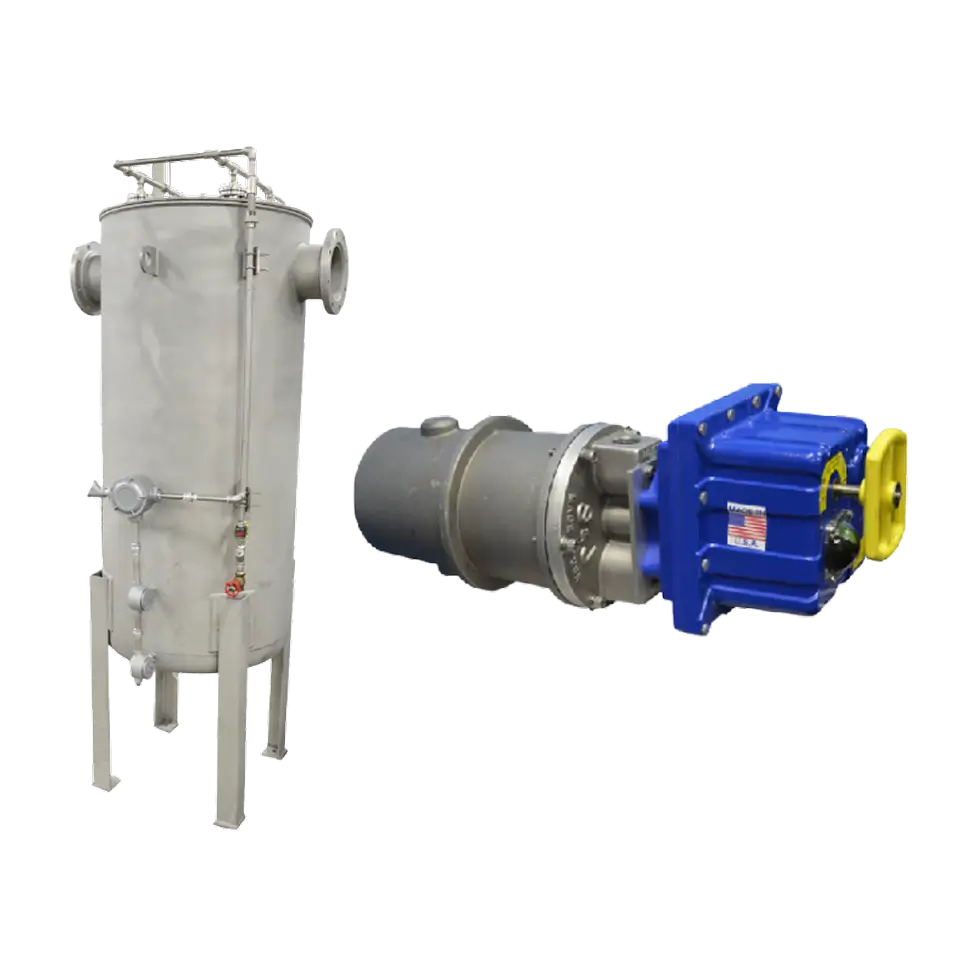
Biogas stream equipment is the set of mechanical devices installed within biogas and digester-gas piping between the anaerobic digester and downstream utilization equipment, including combined-heat-and-power (CHP) engines, flares, gas-upgrading systems, and boilers. These devices protect the piping from flame propagation, remove condensate and solids, regulate operating pressure, and provide local pressure visibility at critical points.
Digester gas is saturated with water vapor that condenses as it cools along the run. Drip traps, in manual, automatic, and electrically actuated configurations, remove condensate at low points before it blocks flow or damages downstream equipment, while sediment traps and accumulators handle solids and collected liquid ahead of discharge.
Pressure regulators hold the low positive pressure digesters require while meeting downstream inlet specifications. Thermal valves isolate the gas path on a temperature excursion, and check valves prevent reverse flow. Flame arresters, in inline-deflagration and detonation configurations, interrupt flame propagation through the piping at severity levels matched to pipe geometry and gas composition. Well-type and U-tube manometers give local pressure indication without electrical connections, supporting operator rounds in wet, corrosive environments.
Biogas stream equipment works as a coordinated system across four device roles, and most installations need devices from more than one. Flame protection addresses combustion safety by hazard severity; condensate and solids handling addresses the physical consequence of water vapor in the gas; pressure control holds conditions within digester and downstream limits; monitoring gives visibility without process or electrical connections. Specifying one role while leaving others unaddressed is a common design error.
Biogas stream equipment is specified when piping between the digester and downstream utilization equipment requires coordinated flame protection, condensate management, pressure control, and monitoring:
A single header may need flame arresters, drip traps, pressure regulators, and manometers together; sourcing all four functions from one supplier simplifies specification, procurement, and commissioning.
Every device is engineered for wet, corrosive, sulfide-containing streams that degrade standard pipeline hardware, with metallic construction and biogas-compatible seals standard across the family.
Manual, automatic, and electrically actuated drip traps let a facility match drainage to available operator resources, from simple manual drains to fully automated, remotely monitored drainage for large multi-digester sites.
Well-type and U-tube manometers give reliable local pressure indication in wet digester environments without electrical connections, supporting operator rounds and troubleshooting where powered instruments are impractical.
| Device Role | Product Family | Best Used When… | Models |
|---|---|---|---|
|
Flame Protection
|
Inline Deflagration Arresters | Flame protection is required within biogas piping against deflagration risk | 94406, 94407 |
|
Flame Protection
|
Detonation Arresters | Detonation or high-severity flame risk exists in long pipe runs | 94311–94314 |
|
Flame Protection
|
Flame Checks | Localized flame blocking is required at a specific interface | 97200 |
|
Flame Protection
|
Thermal Valves | Automatic isolation on a temperature excursion is required | 97130 |
|
Condensate
|
Manual Drip Traps | Manual condensate drainage by an operator is acceptable | 97100, 97101 |
|
Condensate
|
Automatic Drip Traps | Float-operated automatic condensate removal is required | 97110 |
|
Condensate
|
Electrically Actuated Drip Traps | Remote or scheduled drainage from a panel or SCADA is required | 97100E, 97101E |
|
Condensate & Solids
|
Sediment Traps | Solids must be removed to protect downstream equipment | 97120 |
|
Condensate
|
Condensate Accumulators | Condensate collection is required before discharge | 97125 |
|
Pressure Control
|
Single-Port Pressure Regulators | Basic downstream pressure regulation is required | 97150 |
|
Pressure Control
|
Double-Port Pressure Regulators | Enhanced regulation or redundancy is required | 97177 |
|
Pressure Control
|
Back-Pressure Check Valves | Reverse-flow protection is required | 97220 |
|
Monitoring
|
Well-Type Manometers | Local pressure indication without electrical infrastructure is required | 97400 |
|
Monitoring
|
U-Tube Manometers | Visual or differential pressure indication is required | 97401 |
|
Monitoring & Control
|
Local Control Panels | Centralized control of multiple electric drip traps is required | 9710XP |
Consider an alternative when:
Pair inline flame arresters and drip traps in the collection header with cover-mounted conservation vents and flame arresters for complete protection from digester to utilization. See Biogas Cover Equipment.
Connect electrically actuated drip-trap control panels and manometer data to Clairvoyance for centralized monitoring, automated drainage logging, and compliance reporting across multi-digester installations.
Low-point condensate drains for biogas piping, in metallic construction for wet, corrosive, sulfide-containing service.
Maintains a defined downstream pressure for CHP engines, flares, and gas processing, with redundant porting for demanding biogas service.
Well-type and U-tube manometers giving local biogas pressure indication without electrical connections for operator rounds and troubleshooting.