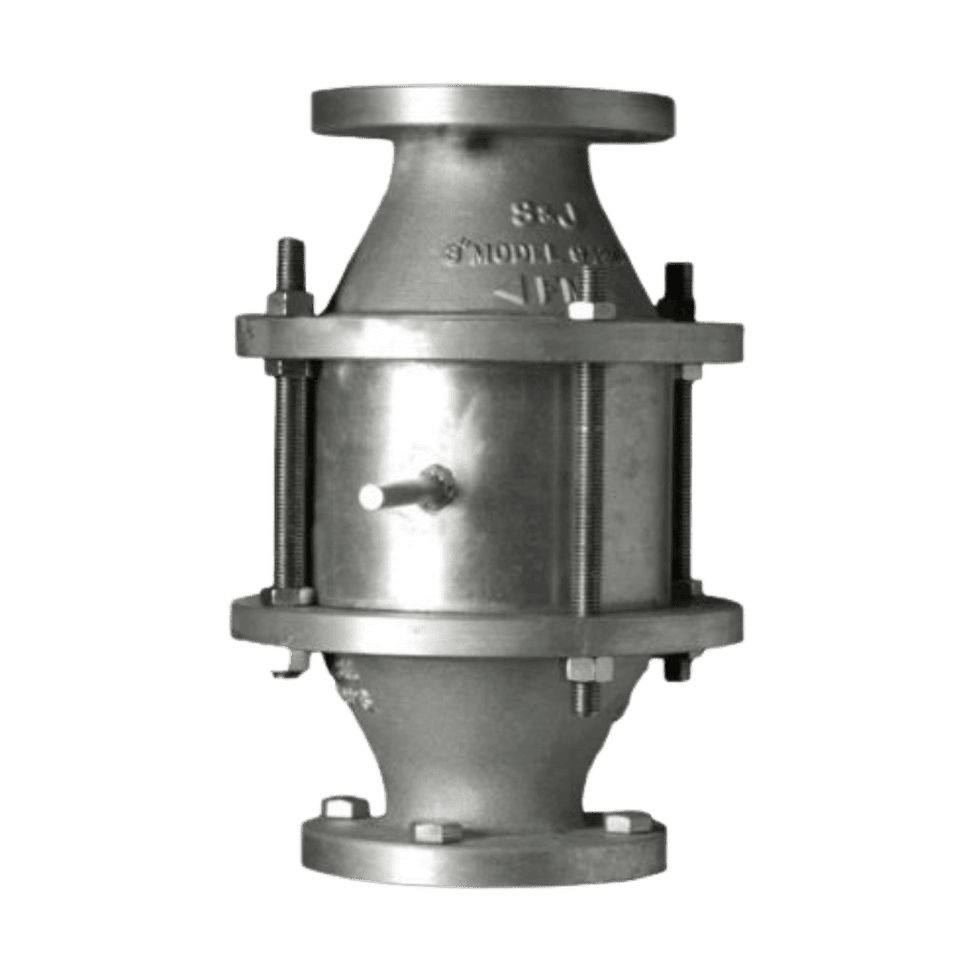
Flame, deflagration, and detonation arresters are passive safety devices that stop a flame front from propagating through tank openings, vent outlets, or interconnected piping into a flammable vapor space. They address the risk of an external ignition source, such as lightning, static discharge, or nearby equipment, reaching stored product through any opening that connects the tank interior to atmosphere or to another vessel.
Each arrester contains a metallic element, typically crimped ribbon or parallel plate, that divides the gas passage into channels narrower than the quenching distance of the target gas group. A flame entering the element loses heat to the metal faster than combustion can sustain it, extinguishing the flame front while allowing normal vapor flow. Element type, gap size, and housing strength determine whether the device arrests a deflagration, a stable detonation, or an unstable detonation.
Arresters mount at tank nozzles, vent-pipe terminations, or inline within piping. Selection depends on installation position, gas group classification, the flame-propagation scenario the device must arrest, and the length-to-diameter (L/D) ratio of connected piping that governs whether a deflagration can transition to detonation.
A deflagration is a flame front traveling below the speed of sound at moderate pressure. A detonation travels at supersonic speed with a high-pressure shock wave. Standard flame arresters stop deflagrations; detonation arresters are built to withstand the shock energy of a supersonic flame front without failing. Specifying the wrong type for the scenario provides no protection.
Flame, deflagration, and detonation arresters are specified wherever a flammable vapor space connects to a potential ignition source through an opening, vent, or piping run:
End-of-line and tank-mounted arresters provide tested, certified flame interruption at every opening where the vapor space meets atmosphere, satisfying NFPA 30 and API 2000 flame-protection requirements at storage tanks.
Inline arresters in a shared vent header keep a flame event at one tank from propagating through the manifold to other connected vessels, isolating the ignition to a single source.
Detonation-rated models arrest a supersonic flame front and its shock wave, protecting long pipe runs where the length-to-diameter ratio creates conditions for a deflagration to accelerate into detonation.
A range spanning plate-element flame arresters through inline deflagration and detonation models lets one source address every flame-hazard severity level across a facility.
| Attribute | End-of-Line / Tank-Mounted | Inline Deflagration | Inline Detonation |
|---|---|---|---|
|
Installation position
|
At a vent outlet or tank nozzle open to atmosphere | Within piping between vessels or to vapor recovery | Within piping where long runs create detonation risk |
|
Flame scenario arrested
|
External ignition propagating inward through the vent | Deflagration, a subsonic flame front, within piping | Detonation, a supersonic flame front with shock wave |
|
Typical length-to-diameter (L/D) ratio
|
Not applicable (open to atmosphere) | Short to moderate pipe runs | Long runs exceeding the deflagration-transition threshold |
|
Pressure Resistance
|
Low: atmospheric vent service | Moderate: deflagration pressures | High: detonation shock-wave energy |
|
Regulatory Driver
|
NFPA 30, API 2000, EPA 40 CFR 60/63 | NFPA 69, EN 12874, site hazard analysis | EN 12874, ATEX/IECEx, site detonation risk assessment |
|
Representative Models
|
94306, 94309 | 94406, 94407 | 9431X (94311–94314) |
|
Recommendation
|
Specify for every atmospheric vent opening on tanks storing flammable liquids | Specify for interconnected piping where deflagration risk exists and the L/D ratio is below the detonation-transition threshold | Specify for long pipe runs where deflagration-to-detonation transition is possible given gas group and pipe geometry |
Consider an alternative when:
Pair end-of-line flame arresters with conservation vents to deliver both emissions-controlled tank breathing and flame interruption at the same vent opening. See Pressure & Vacuum Conservation Vents.
Combine tank-mounted flame arresters with L&J Technologies level alarm probes, emergency vents, and Varec FuelsManager® feeding Clairvoyance to build a layered system covering flame, overfill, and overpressure from sensor to software. See Level Alarms and FuelsManager®.
Tank-mounted and vent-outlet arresters providing certified flame interruption at atmospheric openings on fixed-roof storage tanks.
Inline arresters that interrupt a subsonic deflagration in piping between interconnected vessels or vapor recovery equipment.
Detonation-rated arresters for long pipe runs where gas group and pipe geometry create deflagration-to-detonation transition risk.