97311
97301
01

Waste Gas Burners & Flares

Safe combustion of excess vapors and gases.

What It Is & How It Works

Waste gas burners and flares are combustion devices that safely destroy gases and vapors that cannot be economically recovered or returned to process. They address two related hazards: accumulation of flammable gas mixtures that could reach explosive concentrations if vented uncontrolled, and release of volatile organic compounds (VOCs) and hazardous air pollutants (HAPs) that violate emission regulations. Controlled combustion converts the waste gas to carbon dioxide and water vapor, removing both the explosion risk and the regulatory exposure.

Waste gas flows through supply piping to a burner head where a continuous pilot or automatic ignition initiates combustion. The burner holds a stable flame across a range of flow rates and compositions, with wind shields, retention rings, or an enclosed chamber protecting the flame from extinguishment. A flame monitor, typically a thermocouple or UV sensor, confirms ignition and triggers automatic re-ignition or an alarm if the flame is lost.

Burners and flares are sized from the maximum waste-gas flow rate, the gas heating value in BTU per cubic foot, and the required destruction efficiency. Configurations range from elevated stack-mounted flares to enclosed ground-level units, selected by site constraints, noise, and local permitting.

Waste Gas Burner vs. Flare

The terms are often used interchangeably, but in practice a burner is an enclosed or semi-enclosed device for continuous, low-visibility operation at or near ground level, while a flare is an open-flame device, often elevated, for intermittent or emergency vapor destruction. Both convert waste gas to combustion products safely and within emission limits.

When to Specify Waste Gas Burners & Flares

Waste gas burners and flares are specified when a facility produces combustible waste gas that must be destroyed rather than vented:

  • Wastewater Treatment Plants Producing Digester Gas: Anaerobic digestion produces methane-rich biogas that must be flared when production exceeds engine or boiler demand, when gas quality is insufficient for recovery, or during maintenance of the primary gas-use system.
  • Landfill Gas Collection Systems: Extraction wells produce variable-quality methane that must be destroyed continuously to comply with EPA 40 CFR 60 Subpart WWW and NSPS, even when energy recovery is absent or temporarily offline.
  • Chemical and Petrochemical Process Vents: Vessels, reactors, and tanks generating VOC- or HAP-bearing vapors subject to EPA 40 CFR 60/63 destruction requirements, where vapor recovery is infeasible due to low concentration, variable composition, or incompatible streams.
  • Tank Farm Vapor Destruction: Multi-tank facilities where vapor recovery valves collect displaced vapors during filling and route them to a central burner or flare for destruction, replacing atmospheric venting.
  • Biogas Facilities Requiring Excess Gas Management: Upgrading and conditioning plants where off-spec gas and purge streams from gas cleaning must be combusted to prevent uncontrolled methane release and meet air-quality permit conditions.
Shand & Jurs 97311
02

Why It Excels

01

Facilities with Variable Gas Flow and Composition

Burner designs that hold stable combustion across wide turndown ratios accommodate the fluctuating volumes and heating values typical of digester gas, landfill gas, and intermittent process vents without constant operator adjustment.

02

Sites Where Visible Flame and Noise Must Be Minimized

Enclosed ground-level burners contain the flame within a refractory-lined chamber, eliminating visible flame and sharply reducing combustion noise compared to open elevated flares, satisfying community and permitting constraints.

03

Installations Requiring Automatic, Unattended Operation

Integrated pilot ignition, flame monitoring, and automatic re-ignition allow continuous unattended operation with alarm notification, reducing the operator attention needed to maintain compliant destruction.

04

Permit Applications Requiring Documented Destruction Efficiency

Burner designs tested and documented to achieve 98% or greater destruction efficiency provide the performance data regulators require when issuing air-quality permits for new or modified waste-gas sources.

03

Choosing the Right Waste Gas Combustion Device — Selection Guide

Attribute Elevated Flare Enclosed Ground Burner Utility Burner
Combustion Type
Open flame at an elevated stack tip Enclosed flame in a grade-level chamber Semi-enclosed or open flame at low elevation
Typical Application
Emergency relief, high-volume intermittent venting Continuous destruction, community-sensitive sites Routine low-volume biogas or process-gas flaring
Visible Flame
Yes, visible from a distance No, contained within the enclosure Minimal, low-profile flame
Noise Level
Higher, from open combustion and wind Lower, the chamber attenuates combustion noise Moderate, depends on configuration
Destruction Efficiency
95–98% typical 98%+ with proper design 95–98% typical
Gas Flow Range
High capacity, wide turndown Moderate capacity, wide turndown Low to moderate capacity
Footprint
Small ground footprint, tall stack required Larger ground footprint, no stack Compact, minimal site preparation
Recommendation
  • Specify for high-volume emergency or intermittent destruction where an elevated stack is acceptable and visibility is not a concern
  • Specify for continuous destruction at community-sensitive sites where visible flame and noise must be eliminated
  • Specify for routine low-volume destruction at wastewater plants, small biogas facilities, or modest process vents

What to Consider Alongside Waste Gas Burners & Flares

Consider an alternative when:

  • The waste gas has enough heating value for energy recovery. Engine-generators, boilers, or micro-turbines convert biogas or process gas to electricity or heat rather than destroying it, with a flare or burner as backup when recovery is offline. See Biogas Stream Equipment.
  • Vapors can be captured and returned to process. When displaced tank vapors have value or suit a collection system, vapor recovery routes them back to storage or process rather than destroying them. See Tank Blanketing & Vapor Recovery.
  • The gas stream needs cleaning before any end use. When biogas carries high hydrogen sulfide, siloxanes, or moisture, conditioning upstream of the burner improves combustion and extends burner life. See Biogas Stream Equipment.

How Waste Gas Burners and Flares Fit Into a Larger System

  • Pair burners with biogas cover equipment for gas collection, biogas stream conditioning for gas cleaning, and vapor recovery valves for tank vapor routing to build a complete capture, treatment, and destruction system from digester to stack. See Biogas Cover Equipment, Biogas Stream Equipment, and Tank Blanketing & Vapor Recovery.
  • Combine burner operation with L&J Technologies flow and temperature instrumentation feeding Clairvoyance to log destruction volumes, pilot status, and combustion temperatures for air-quality permit reporting. See Data Transmitters and FuelsManager®.
04

Featured Products

01

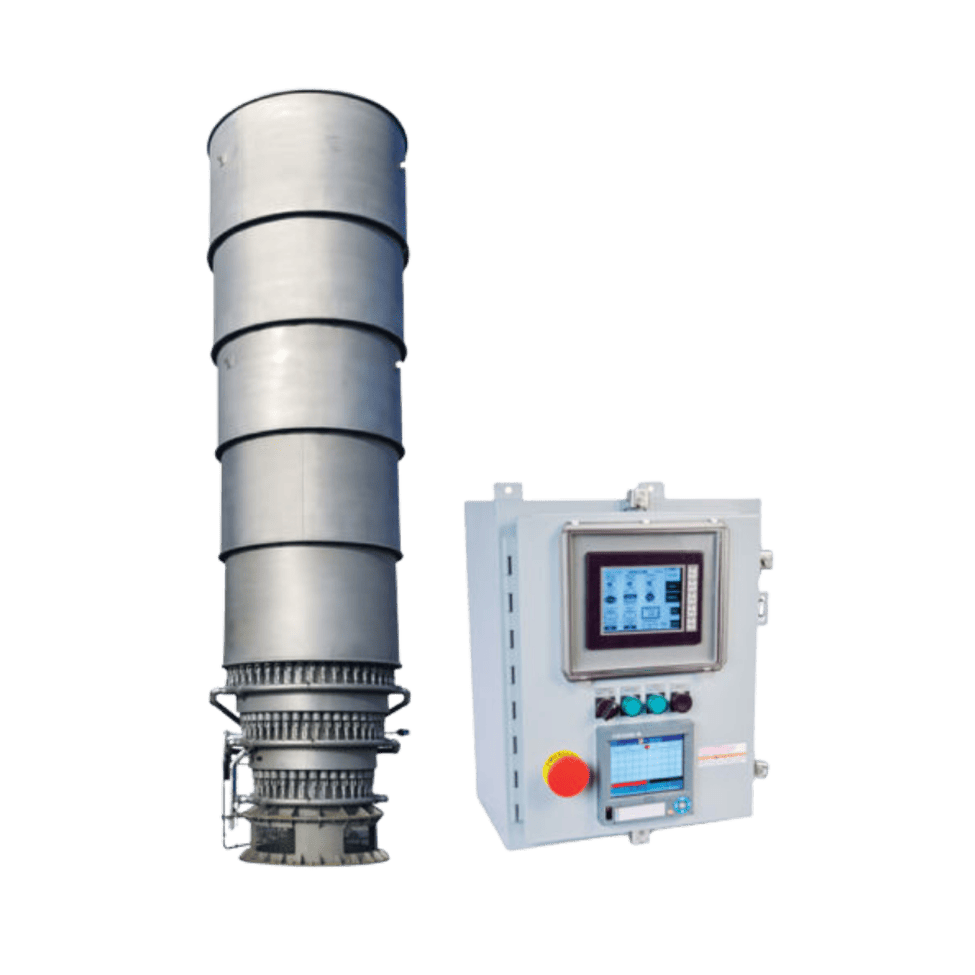
Shand & Jurs 97311 Enclosed Waste Gas Burner

Ground-level enclosed combustion for continuous destruction of biogas, landfill gas, and process vapors with no visible flame and minimal noise.

02

Shand & Jurs 97301 Elevated Waste Gas Flare

Stack-mounted open flare for high-volume emergency and intermittent waste-gas destruction at petroleum, chemical, and biogas facilities.

03

Shand & Jurs 97300M Utility Gas Burner

Compact, low-volume gas destruction for wastewater digester gas, small biogas facilities, and routine process-vent applications.

05

Sizing a burner or flare for your waste-gas stream?

Talk to an engineer
Shand & Jurs
Measure.
Monitor.
Protect.