Centrifugal Gas Sediment Trap
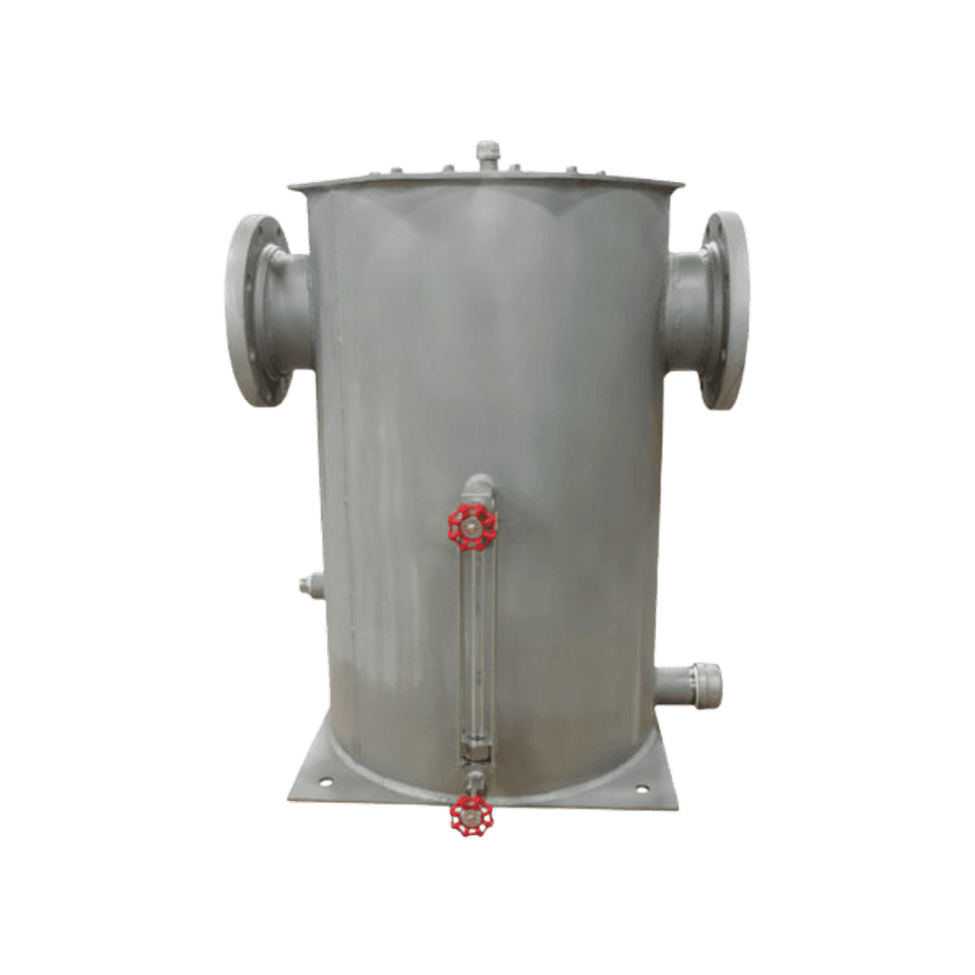
For digester plant engineers, landfill gas operators, and flare-train designers, the Shand & Jurs 97120 Sediment Trap removes bulk condensate and particulate from wet gas streams before the gas reaches regulators, flame arresters, burners, or flare systems, preventing corrosion, fouling, and water hammer events at the source.
Unlike simple drip legs or inline filters that rely on settling or media filtration, the 97120 uses a tangential centrifugal inlet to induce rotational flow and rapid velocity reduction, separating entrained liquids and solids from the gas stream before they can migrate downstream through the conditioning train.
The vessel provides a minimum 6-gallon liquid and 6-gallon sediment capacity across line sizes from 2 inches to 20 inches, with working pressures from 5 PSIG up to 25 PSIG. Steel or 316/316L stainless construction, an optional internal cooling coil, and integrated cleanout and drain connections support wet or saturated gas service.
Within the Shand & Jurs gas conditioning family, the 97120 sits upstream of drip traps, accumulators, and purifiers as the primary bulk-contaminant removal stage on digester, landfill, fuel gas, and vapor recovery headers.
Induces rotational flow and velocity reduction, separating entrained liquids and solids from the gas stream before downstream transport.
Minimum 6 gallons of liquid and 6 gallons of solids capacity supports extended service intervals in wet and contaminated gas applications.
Maintains stable gas flow while removing bulk contaminants, avoiding the nuisance regulator and burner upsets caused by high resistance.
Circulating water promotes additional moisture condensation, improving liquid removal efficiency in saturated digester and landfill gas streams.
2-inch NPT blowout and 1-inch NPT drip trap ports allow safe removal of accumulated liquid and sediment without breaking process containment.
Broad size envelope with ANSI RF or FF flange connections fits bulk conditioning duty on small lateral drops through main plant headers.
Bulk gas sediment and condensate separator
Tangential centrifugal separation with velocity reduction
5 PSIG standard, up to 25 PSIG
2″ – 20″
ANSI RF or ANSI FF
Minimum 6 gallons
Minimum 6 gallons
Low-pressure-drop design
2″ NPT
1″ NPT
Carbon Steel or 316/316L Stainless Steel
316 Stainless Steel
CR (Neoprene)
316 Stainless Steel or Bronze
316 Stainless Steel
Internal cooling coil, sight glass with isolation valves, epoxy or galvanized finishes, specialty vessel designs, insulation jacket
If you have questions not covered here, please contact the Cognesense support team for assistance.
Contact Us ↵Gas enters through a tangential nozzle, inducing rotational flow inside the vessel. Centrifugal force drives the heavier entrained liquid droplets and solid particles to the vessel wall, where they fall out of the stream into the storage volume below. The purified gas exits at a lower velocity through the outlet, leaving bulk contaminants behind.
The 97120 is the first-stage bulk contaminant removal vessel. It sits upstream of drip traps, accumulators, and H₂S purifiers so that regulators, flame arresters, burners, and flares downstream receive gas that has already had bulk liquid and solids removed.
Specify the cooling coil in saturated gas service, where additional condensation within the vessel improves overall liquid removal efficiency. Circulating cooling water through the coil drops the gas below its dew point inside the separator, so more moisture falls out before the gas exits to downstream equipment.
The 97120 is offered in line sizes from 2 inches to 20 inches with ANSI RF or FF flange connections. Construction is carbon steel standard or 316/316L stainless steel for aggressive service, with 316 stainless hardware and CR soft goods. Sight glass assemblies are stainless or bronze; cooling coil assemblies are 316 stainless.
Standard working pressure is 5 PSIG, with designs available up to 25 PSIG. This matches the typical operating envelope of low-pressure digester gas, landfill gas, and fuel gas distribution headers. Higher-pressure service is addressed by separate products in the Shand & Jurs biogas product category.
A 2-inch NPT blowout connection supports sediment removal, and a 1-inch NPT drip trap connection allows pairing with a 97100 or 97110 drip trap for routine condensate drainage. This combination keeps the main vessel online while accumulated material is removed safely through purpose-built connections.
Yes. By removing bulk liquid and particulate at the inlet of the conditioning train, the 97120 prevents regulator freeze-up, flame arrester blockage, burner misfires, and meter fouling downstream. Sites that install the 97120 as the first stage typically see longer service intervals across the whole gas utilization system.
With over a century of tank-safety heritage, Cognesense delivers the Shand & Jurs 97120 Sediment Trap as the first-stage bulk contaminant removal vessel for digester gas, landfill gas, fuel gas, and flare system piping. Tangential centrifugal separation drops liquids and solids out of the stream with low pressure drop, while 6-gallon liquid and sediment capacity, carbon or 316 stainless construction, and an optional cooling coil match service conditions from standard utility gas to saturated biogas. Paired with drip traps and purifiers downstream, the 97120 is trusted wherever you need to measure, monitor, and protect what matters most.