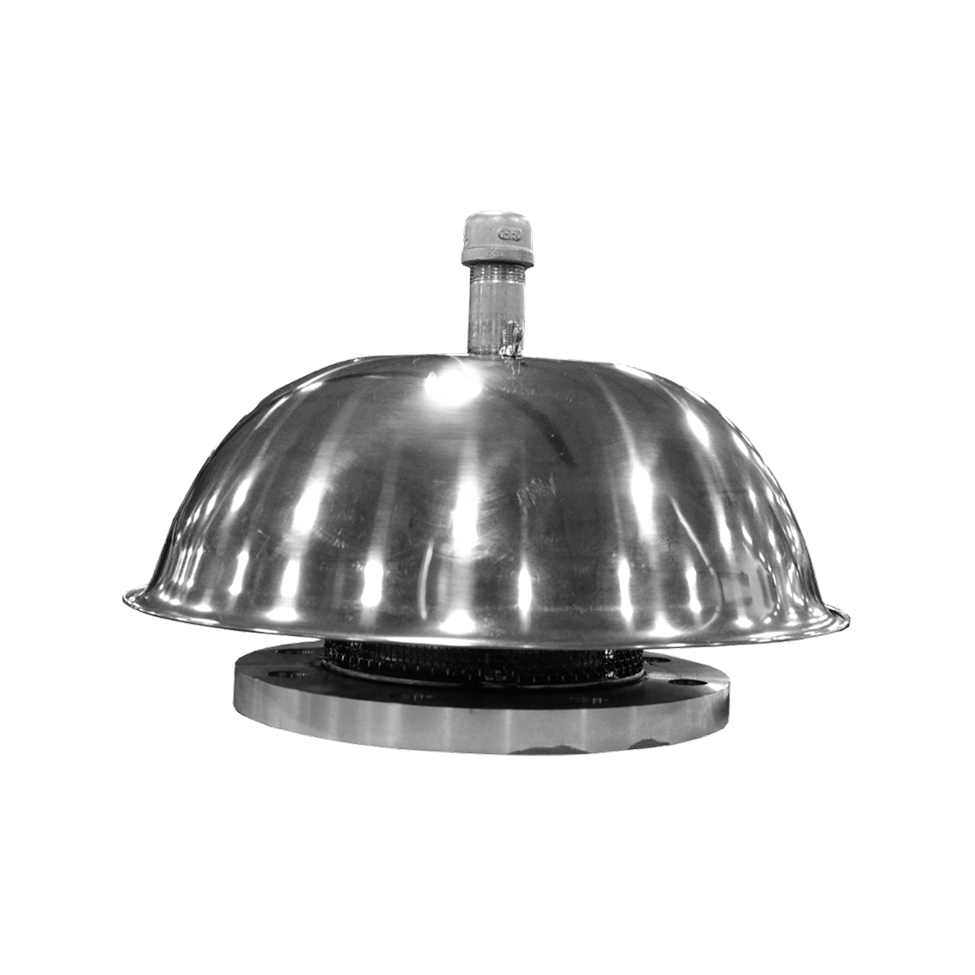
Pressure conservation vents are weight-loaded relief devices that protect storage tanks from overpressure, releasing vapor when internal pressure exceeds a calibrated set point. They guard against shell deformation or roof failure from pressure buildup during thermal expansion, product filling, or inert gas blanketing overshoot. Pressure-only models carry a single pressure pallet and no vacuum relief mechanism.
The pallet sits on a machined seat at the top of the vent body, held closed by calibrated weights. When internal pressure exceeds the weight load, the pallet lifts and vapor escapes to atmosphere; when pressure drops below the set point, it reseats under its own weight, cycling automatically with each event.
Vents mount on standard tank roof nozzles, sized per API 2000 for the tank’s maximum out-breathing rate. Set points adjust by adding or removing weights, and construction comes in carbon steel, stainless steel, or aluminum to match the product’s vapor characteristics.
A combined Pressure & Vacuum conservation vent provides both pressure and vacuum relief in one device. A pressure-only vent omits the vacuum pallet, relying on a separate blanketing valve or dedicated vacuum vent for vacuum conditions. Specify pressure-only when another device already manages vacuum relief at the same tank.
Pressure conservation vents are specified when a tank requires overpressure relief at a dedicated nozzle while vacuum relief is handled separately:
Relieving pressure without a vacuum pallet lets blanket gas escape only on overpressure, while a separate blanketing valve holds the inert atmosphere.
The Expanda-Seal™ diaphragm option holds leakage to no more than 0.5 SCFH at 95% of set point, reducing blowdown and vapor loss.
The single-pallet, weight-loaded design has no springs to fatigue and no pilots to maintain, giving years of service between rebuilds.
When pressure-relieved vapors must be routed to a vapor recovery unit, scrubber, or thermal oxidizer, a dedicated pressure vent provides a single-purpose outlet that can be directly piped to the collection system without routing vacuum air intake through the same path.
| Attribute | Pressure & Vacuum Conservation Vent | Pressure-Only Vent | Vacuum-Only Vent |
|---|---|---|---|
|
Primary Function
|
Both pressure and vacuum relief in one device for bidirectional breathing | Overpressure relief only; vacuum handled by a separate device or not required | Vacuum relief only; pressure handled by a separate device such as a blanketing valve |
|
Pallet Configuration
|
Two pallet stacks, pressure and vacuum, in one housing | Single pressure pallet; no vacuum pallet | Single vacuum pallet; no pressure pallet |
|
Typical Set-point Range
|
Pressure 0.5 to 16 oz/sq in.; vacuum 0.5 to 8 oz/sq in. (weight-adjustable) | 0.5 to 16 oz/sq in. pressure (weight-adjustable) | 0.5 to 8 oz/sq in. vacuum (weight-adjustable) |
|
When to Specify
|
Default for most atmospheric fixed-roof tanks needing both reliefs at one nozzle | Blanketed tanks where a separate valve handles vacuum makeup and only pressure relief is needed | Tanks where a separate pressure vent or pilot valve handles pressure relief |
|
Regulatory Driver
|
API 2000, EPA 40 CFR 60/63, NFPA 30 | API 2000 pressure sizing, often with blanketing valves | API 2000 vacuum sizing, API 650 structural vacuum limits |
|
Common Pairing
|
Flame arrester at outlet; emergency vent for fire case | Blanketing valve for vacuum makeup; flame arrester at outlet | Pressure vent or blanketing valve for pressure relief |
|
Recommendation
|
|
|
|
Consider an alternative when:
Weight-loaded overpressure relief for blanketed and sealed atmospheric tanks, sized per API 2000 to hold a vapor-tight seal below set point.
Spring-loaded pressure relief for tanks needing consistent set-point performance across temperature swings and at higher set pressures.
Corrosion-resistant pressure relief for chemical service whose vapors attack carbon steel components, holding seal integrity in aggressive environments.