01

9414X Series Spring-Loaded Pressure Conservation Vent

Spring-Loaded Pressure Conservation Vent

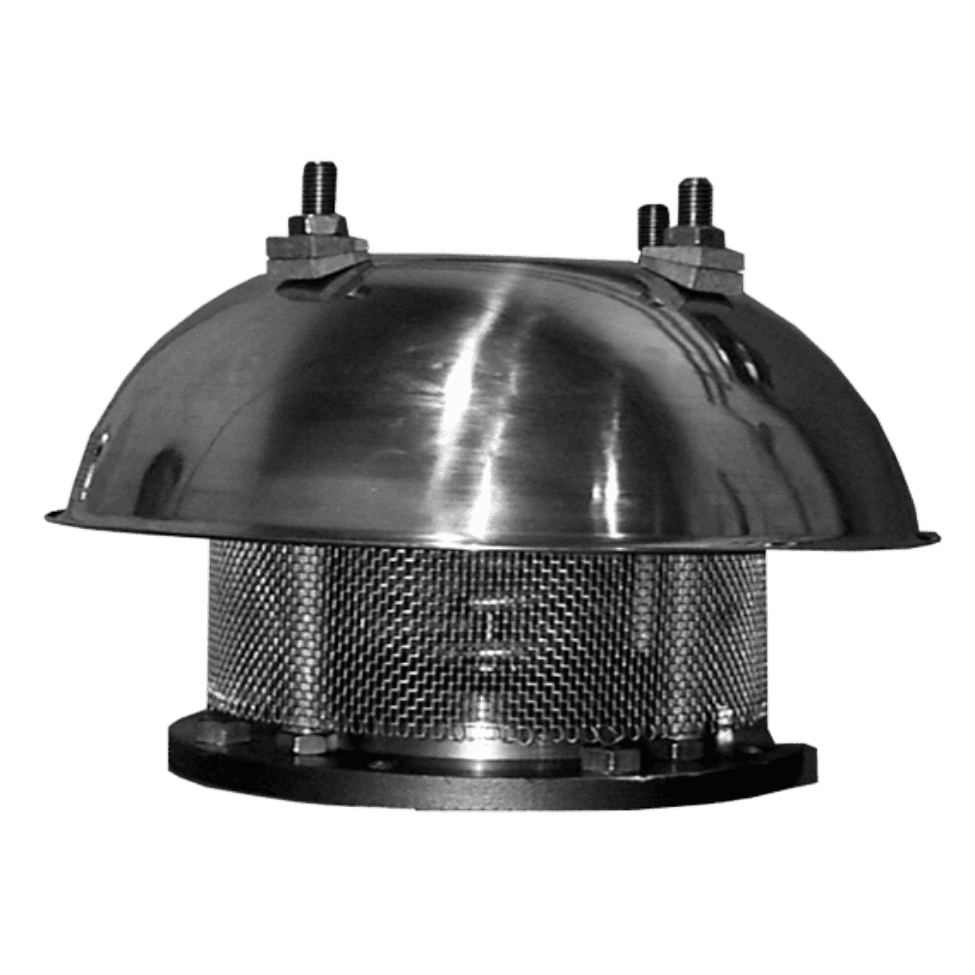
Shand & Jurs 9414X Series Spring-Loaded Pressure Conservation Vent

For refinery engineers, chemical-plant specifiers, and terminal operators, the Shand & Jurs 9414X Series spring-loaded pressure conservation vent protects storage tanks that operate above the weight-loaded envelope, with setpoints from 1 to 15 PSIG.

Unlike weight-loaded vents that are constrained to low-pressure service, spring loading holds the pallet firmly seated at elevated setpoints and stays stable under vibration and pressure oscillation, so setpoint control does not drift with flow or movement.

Guided pallet geometry maintains alignment under load, ensuring controlled lift and consistent reseating. An air-cushion FEP diaphragm seals tightly and resists sticking from condensate or ice. Optional Expanda-Seal increases sealing force as pressure approaches setpoint, holding leakage under 0.5 SCFH at 95 percent.

Three configurations — open (94140), closed outlet-larger-than-inlet (94141), and equal-size closed (94142) — fit atmospheric, pipe-away, and vapor-recovery routings. WinSize software supports sizing; ANSI 150 and EN PN16 drillings are standard.

Shand & Jurs 94140
Shand & Jurs 9414X Series Spring-Loaded Pressure Conservation Vent
02

Features

Spring-Loaded Relief Assembly

Delivers stable relief control from 1 to 15 PSIG (12 PSIG on 12-inch), extending conservation venting beyond weight-loaded limits for elevated tank pressures.

Guided Pallet Alignment

Maintains lift stability and controlled reseating under high-pressure loading, resisting vibration and cycling excursions that shift setpoints on unguided designs.

Air-Cushion FEP Diaphragm

Supports tight sealing while resisting adhesion from condensate or icing, maintaining predictable blowdown performance during routine breathing cycles.

Expanda-Seal Option

Available on setpoints of 1.5 PSIG and higher, holding leakage under 0.5 SCFH at 95% of setpoint versus ~1.0 SCFH at 90%.

Integral Body Seats

Seats cast integral to the body eliminate seat-to-body joint leak paths, supporting long-term setpoint stability and reducing service-related failure modes.

ANSI 150 and EN PN16 Flanges

Standard flange drillings align with refinery, terminal, and chemical-plant piping specifications across North American and European installations.

Applications

  • High-Pressure Storage Tanks: Provides overpressure protection for tanks operated above the weight-loaded envelope, with setpoints spanning 1 to 15 PSIG across standard nominal sizes.
  • Petroleum Terminals: Supports elevated-pressure service on product and intermediate storage where weight-loaded vents cannot reach the required relief setting.
  • Chemical Processing: Controls routine breathing on solvent, acid, and specialty-chemical storage where operating pressure exceeds the low-pressure range of weight-loaded designs.
  • Closed Vent Systems: Closed 94141 and 94142 configurations route routine breathing into vapor-recovery or control-system piping rather than discharging to atmosphere.
  • Corrosive Vapor Service: 316 stainless steel body and alternate diaphragm elastomers extend compatibility for acid, caustic, and aggressive chemical vapor handling.
  • Emissions-Controlled Facilities: Expanda-Seal option limits leakage near setpoint, supporting reduced-emission operating programs at VOC-regulated terminals and chemical sites.
03

Specifications

Parameter

Specification

Device Type

Spring-loaded pressure conservation vent

Models

94140 (open), 94141 (closed, outlet > inlet), 94142 (closed, equal-size)

Set Pressure Range

1–15 PSIG (size dependent); 12-inch maximum 12 PSIG

Expanda-Seal Minimum Setpoint

1.5 PSIG

Leakage (Expanda-Seal)

<0.5 SCFH at 95% of setpoint

Sealing Method

Air-cushion seated diaphragm

Loading Method

Spring loaded

Integral Seats

Seats integral to the body casting

Nominal Sizes

2″, 3″, 4″, 6″, 8″, 10″, 12″

Flanged Connections

ANSI Class 150 FF; EN1092-1 PN16 FF

Temperature Range (Aluminum)

−65°F to +250°F (−54°C to +121°C)

Temperature Range (316 SS)

−65°F to +350°F (−54°C to +177°C)

Temperature Range (Carbon Steel)

−20°F to +350°F (−29°C to +177°C)

Body and Seat

Aluminum, Carbon Steel, or 316 Stainless Steel

Pallets

Aluminum or 316 Stainless Steel

Diaphragm

FEP (standard); FKM, NBR, or PFA available

Spring

Stainless Steel

Hardware

316 Stainless Steel

Sizing Support

Shand & Jurs WinSize (EZ-Flow) software

Options

Expanda-Seal pallet, closed vent configuration, All-Weather Teflon coating, ATEX certification (≤ 7.25 psig; higher-pressure ATEX consult factory), material upgrades, EN1092-1 PN16 flange option

Contact Support
2026 COST ESTIMATE

Contact Support

If you have questions not covered here, please contact the Cognesense support team for assistance.

Contact Us

When should I specify a spring-loaded vent over a weight-loaded vent?

Weight-loaded conservation vents (the 9413X family) cover low-pressure atmospheric-tank service up to about 24 oz/in² (roughly 1.5 PSIG). When the tank operates at a higher pressure — 1 to 15 PSIG — a spring-loaded vent like the 9414X is the correct choice. Spring loading is also more tolerant of vibration and pressure oscillation, so setpoint stability is better in service environments where movement or cycling would shift a weight-loaded pallet.

What is the difference between the 94140, 94141, and 94142?

+

The 94140 is an open vent with a weather hood discharging to atmosphere. The 94141 is a closed vent with an outlet larger than the inlet, configured for pipe-away routing. The 94142 is a closed vent with equal-size inlet and outlet connections. Pick the configuration based on how you are routing routine breathing — atmosphere, vapor recovery, or a control-system header.

Is ATEX certification available at all setpoints?

+

ATEX certification is available as standard up to 7.25 psig (0.5 barg). For higher-pressure ATEX requirements, consult the factory — certification is provided on a configuration-specific basis.

How does Expanda-Seal differ from the standard pallet on this series?

+

The standard pallet relies on a weighted or spring-loaded diaphragm seal and leaks about 1.0 SCFH at 90% of setpoint. Expanda-Seal is a self-energizing seal that tightens as pressure approaches setpoint, holding leakage under 0.5 SCFH at 95%. It is available on setpoints 1.5 PSIG and higher, and it is recommended where fugitive emissions or blanketing-gas loss near setpoint is operationally or economically significant.

What sizing support is provided?

+

Shand & Jurs WinSize (EZ-Flow) software walks engineers through capacity, pressure, and size selection for the 9414X and produces defensible documentation for engineering review. Sizing follows API 2000 methodology.

What diaphragm materials are available for chemical service?

+

Standard diaphragm material is FEP. FKM, NBR, and PFA are available as alternate elastomers to extend temperature range and chemical compatibility for condensate, corrosive-vapor, and high-temperature applications.

Summary

With over a century of tank-safety heritage inside Cognesense, the Shand & Jurs 9414X Series spring-loaded pressure conservation vent extends conservation venting beyond weight-loaded limits, delivering 1 to 15 PSIG setpoints for elevated tank operating envelopes. Guided pallet geometry, integral body seats, diaphragm sealing, and optional Expanda-Seal support stable control, controlled blowdown, and reduced vapor leakage. With WinSize sizing support and ANSI 150 / EN PN16 flanges, the 9414X fits within Cognesense’s tank-safety portfolio to help refineries and chemical sites measure, monitor, and protect what matters most.

Shand & Jurs
Measure.
Monitor.
Protect.