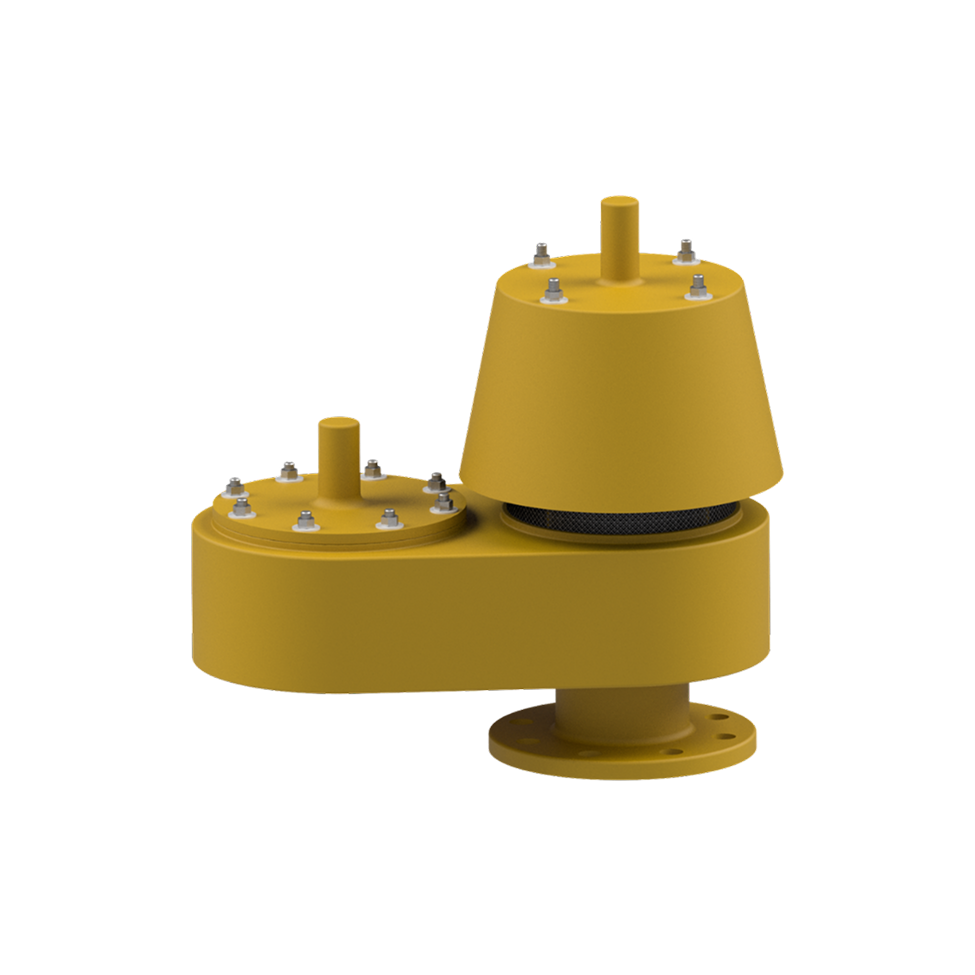
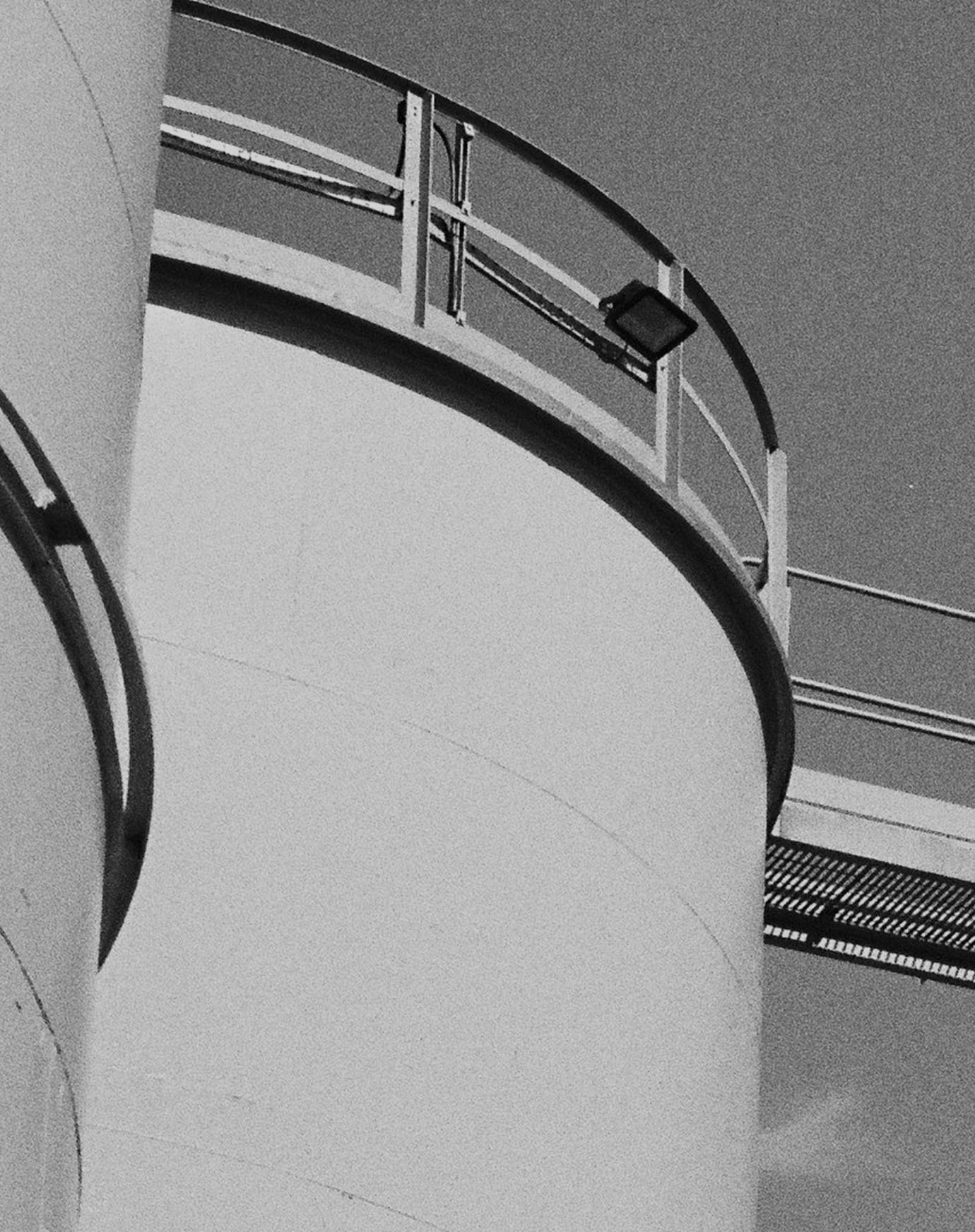
Pressure and vacuum conservation vents are weight-loaded relief devices mounted on storage tank roofs that let a tank breathe in a controlled way. They protect the shell from overpressure and vacuum damage caused by thermal expansion, product transfer, and ambient temperature changes, while minimizing vapor release to atmosphere. Every fixed-roof atmospheric tank must breathe, and the conservation vent ensures it does so only when pressure or vacuum exceeds a safe threshold.
The vent carries two independent pallet assemblies, one for pressure and one for vacuum, each held closed by calibrated weights. When tank pressure exceeds the pressure set point, the pressure pallet lifts to release vapor; when vacuum exceeds the vacuum set point, the vacuum pallet lifts to admit air. Both reseat automatically when the condition normalizes, requiring no external power, control signals, or operator action.
Conservation vents mount on standard roof nozzles and are sized per API 2000 from the tank’s thermal breathing rate and maximum pumping rates. Set points adjust by adding or removing weights, and materials are selected to match the product’s vapor corrosivity.
Conservation vents handle normal breathing during routine operations, pumping, and temperature changes. Emergency vents handle abnormal overpressure from external fire or equipment failure, delivering the large-volume relief a conservation vent is not sized for. Most tanks need both: a conservation vent for daily breathing, an emergency vent for fire-case protection.
Conservation vents are specified on virtually every fixed-roof atmospheric tank that must control vapor emissions while preventing pressure and vacuum damage:
Weight-loaded pallets operate purely on the pressure differential between vapor space and atmosphere, needing no electricity, pneumatics, control signals, or operator action to protect through power and control-system failures.
The sealed pallet design keeps the vapor space closed during normal conditions, releasing vapor only above the set point and lowering the cumulative fugitive emissions that feed Title V inventories.
A common vent platform across dozens or hundreds of tanks allows standardized spares, consistent maintenance procedures, and uniform operator training across the facility.
Adjustable weight stacks let the same vent body be recalibrated for new set points when the stored product changes, accommodating seasonal switches without replacing the device.
| Attribute | Pressure & Vacuum Conservation Vent | Pressure-Only Vent | Vacuum-Only Vent | |
|---|---|---|---|---|
|
Primary Function
|
Both pressure and vacuum relief in one device for bidirectional breathing | Overpressure relief only; vacuum handled by a separate device or not required | Vacuum relief only; pressure handled by a separate device such as a blanketing valve | |
|
Pallet Configuration
|
Two pallet stacks, pressure and vacuum, in one housing | Single pressure pallet; no vacuum pallet | Single vacuum pallet; no pressure pallet | |
|
Typical Set-point Range
|
Pressure 0.5 to 16 oz/sq in.; vacuum 0.5 to 8 oz/sq in. (weight-adjustable) | 0.5 to 16 oz/sq in. pressure (weight-adjustable) | 0.5 to 8 oz/sq in. vacuum (weight-adjustable) | |
|
When to Specify
|
Default for most atmospheric fixed-roof tanks needing both reliefs at one nozzle | Blanketed tanks where a separate valve handles vacuum makeup and only pressure relief is needed | Tanks where a separate pressure vent or pilot valve handles pressure relief | |
|
Regulatory Driver
|
API 2000, EPA 40 CFR 60/63, NFPA 30 | API 2000 pressure sizing, often with blanketing valves | API 2000 vacuum sizing, API 650 structural vacuum limits | |
|
Common Pairing
|
Flame arrester at outlet; emergency vent for fire case | Blanketing valve for vacuum makeup; flame arrester at outlet | Pressure vent or blanketing valve for pressure relief | |
|
Recommendation
|
|
|
|
Consider an alternative when:
Tighter emission control or higher relief capacity is required. Pilot-operated relief valves provide a snap-action seal that eliminates the seat leakage weight-loaded vents allow near the set point, at higher effective capacity through the same nozzle. See Pilot Operated Relief Valves.
The tank needs only atmospheric open venting with weather protection. For non-volatile products at atmospheric pressure without emission concerns, a free vent breathes openly at lower cost. See Free Vents.
Corrosive service requires full FRP construction throughout. Where the vapor attacks metallic parts, FRP vents provide complete corrosion resistance from housing to pallet. See FRP Vents & Hatches.
Combined weight-loaded pressure and vacuum relief for atmospheric tanks, minimizing fugitive emissions during normal operations.
Spring-loaded bidirectional relief for tanks needing consistent set points across temperature swings and at higher pressures.
Corrosion-resistant pressure and vacuum relief for tanks storing chemicals or acids whose vapors attack carbon steel components.