01

9404X Series Spring-Loaded Conservation Vent

Spring-Loaded Conservation Vent

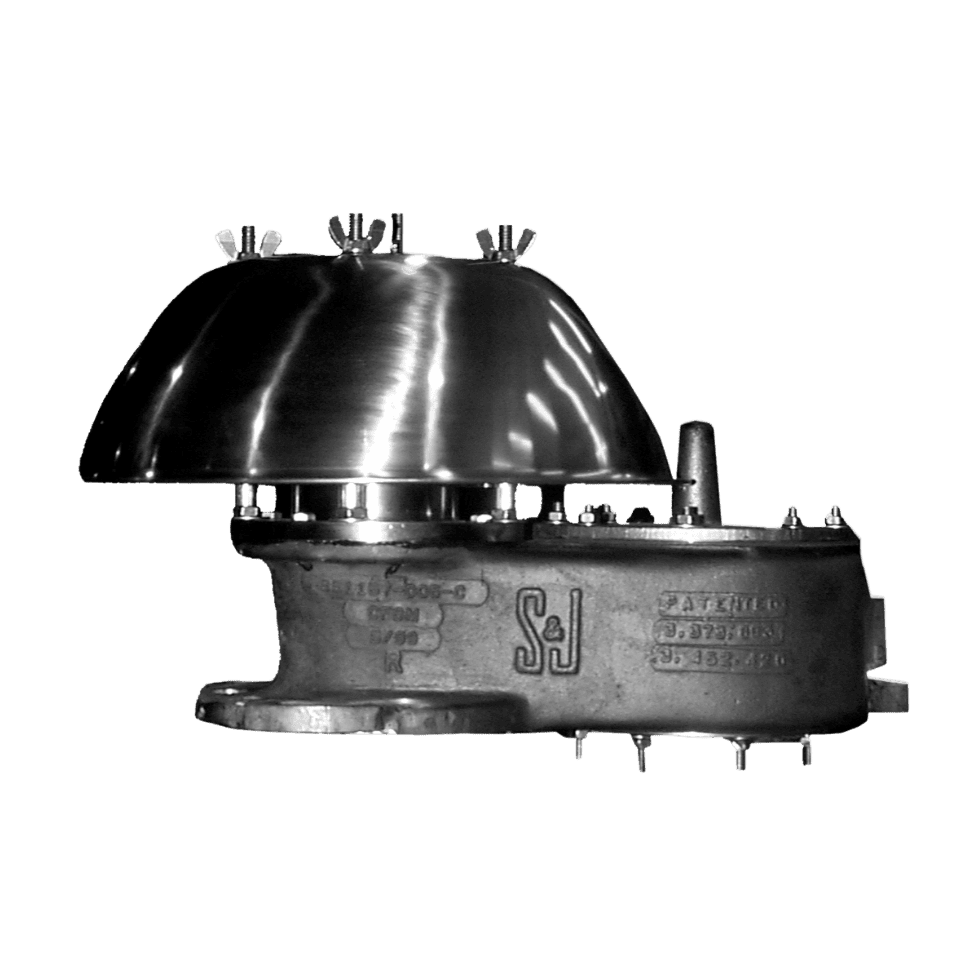
Shand & Jurs 9404X Series Spring-Loaded Conservation Vent

For terminal operators, blanketing-system engineers, and petrochemical specifiers, the Shand & Jurs 9404X Series provides pressure and vacuum relief for atmospheric and low-pressure storage tanks that require elevated pressure settings beyond weight-loaded designs.

Unlike weight-loaded vents that cannot hold setpoints above about 1 psi, and unlike pilot valves that add pilot complexity, the 9404X uses a calibrated stainless steel spring assembly to deliver repeatable 1–15 psig pressure setpoints with a diaphragm-sealed weight-loaded vacuum pallet for controlled air ingress.

Expanda-Seal technology is available: it increases sealing force as operating pressure approaches setpoint, holding leakage under 0.5 SCFH at 95% of setpoint versus roughly 1 SCFH at 90% for a standard spring-loaded design. Relief is sized per API 2000 using Shand & Jurs WinSize.

Three discharge configurations — 94040 open, 94041 pipe-away (outlet > inlet), and 94042 equal-size closed — align the vent with nitrogen blanketing, vapor conservation, or atmospheric discharge strategies on petroleum, chemical, and petrochemical tanks.

Shand & Jurs 94040
Shand & Jurs 9404X Series Spring-Loaded Conservation Vent
02

Features

Spring-Loaded Pressure Pallet

Maintains repeatable opening pressure across 1–15 psig (1–12 psig at 12″) with limited overpressure during lift, holding setpoint under dynamic tank conditions.

Weight-Loaded Vacuum Pallet

Opens at a low differential vacuum to admit air without a rapid pressure swing, protecting roofs, seals, and appurtenances during pump-out and rapid cooling.

Cushion-Seated Teflon Diaphragm

FEP diaphragm helps maintain a tight seal and minimal blowdown during cycling, limiting nuisance losses and supporting stable, repeatable relieving performance.

Expanda-Seal Option

Sealing force rises as pressure approaches setpoint, holding leakage under 0.5 SCFH at 95% of setpoint to cut sustained vapor loss near operating pressure.

Three Discharge Configurations

Open, pipe-away, and equal-size closed variants connect to atmospheric release, vapor recovery headers, or remote discharge piping as site strategy requires.

Broad Material Options

Aluminum, cast steel, and 316 stainless bodies with FEP, FKM, PFA, or NBR diaphragms support corrosive and toxic service without major design changes.

Applications

  • Fuel Terminals: Controls breathing emissions on higher-pressure gasoline, distillate, and finished-product tanks where elevated setpoints reduce routine vapor loss at pumping and thermal cycles.
  • Nitrogen-Blanketed Tanks: Higher operating pressure reduces inert gas consumption and routine breathing losses, stabilizing blanketing across moisture- or oxidation-sensitive product services.
  • Petrochemical Storage: Delivers repeatable 1–15 psig relief for hydrocarbon feedstocks and intermediates where stable pressure control limits evaporative losses and stabilizes downstream processing.
  • Process Vessels: Supports pressure-rated process vessels that operate above standard atmospheric limits, providing controlled overpressure and vacuum relief without complex pilot hardware.
  • Oil and Gas Facilities: Material flexibility and ATEX options up to 7.25 psig (0.5 barg) suit upstream and midstream storage where vapor chemistry and hazardous area classification vary.
  • VOC-Regulated Tanks: Published leakage figures (<1 SCFH standard, <0.5 SCFH Expanda-Seal) support defensible emissions reporting and permit documentation on VOC-controlled storage sites.
03

Specifications

Parameter

Specification

Device Type

Spring-loaded conservation vent (pressure) with weight-loaded vacuum pallet

Models

94040 (open), 94041 (pipe-away, outlet > inlet), 94042 (closed, equal sizes)

Standard Set Pressure

1–15 psig (2″–10″); 1–12 psig (12″)

Adjustable Range

Consult factory for specific setpoint ranges

Leakage Performance

  • Expanda-Seal: <0.5 SCFH air at 95% of setpoint.
  • Standard pallet: <1 SCFH air at 90% of setpoint

Sealing Method

Spring-loaded (pressure); weight-loaded (vacuum)

Loading Method

Spring for pressure relief; weight for vacuum relief

Nominal Sizes

2″, 3″, 4″, 6″, 8″, 10″, 12″

Flanged Connections

ANSI Class 150 FF (standard); RF available except aluminum; EN1092-1 PN16 FF available

Body Materials

Aluminum, Carbon Steel, 316 Stainless Steel

Integral Seats and Pallets

Aluminum or 316 Stainless Steel

Spring (Pressure Assembly)

Stainless steel

Diaphragm / Seal

FEP, FKM, PFA, NBR

Fasteners and Trim

316 Stainless Steel

Weights (Vacuum Pallet)

Lead (standard); Stainless Steel available

Temperature Range

Dependent on body material and seal selection. FEP: −65°F (−54°C) to +400°F (+204°C). Consult factory for specific combinations

Sizing Basis

API 2000 (Shand & Jurs WinSize)

Approvals

ATEX available up to 7.25 psig (0.5 barg); higher settings consult factory

Contact Support
2026 COST ESTIMATE

Contact Support

If you have questions not covered here, please contact the Cognesense support team for assistance.

Contact Us

When should the 9404X be specified over the weight-loaded 9402X?

The 9402X is limited to low-pressure (typically under 1 psi) service. When the tank design calls for elevated setpoints between 1 and 15 psig, the spring-loaded 9404X is the correct selection. Below roughly 1 psi, the 9402X weight-loaded design is preferred for stability and simplicity.

How does spring-loaded relief differ from pilot-operated relief?

+

Spring-loaded vents begin to lift as tank pressure approaches setpoint, with controlled overpressure during full lift. Pilot-operated valves such as the Shand & Jurs 94640 hold the main seat loaded until setpoint is reached and then fully open. Spring-loaded designs are simpler and less costly; pilot-operated designs minimize blowdown for near-setpoint operation.

What leakage performance should I expect?

+

A standard spring-loaded pallet leaks under 1 SCFH at 90% of setpoint. The Expanda-Seal option reduces leakage to under 0.5 SCFH at 95% of setpoint by increasing sealing force as operating pressure approaches setpoint, cutting sustained near-setpoint vapor losses.

Is the 9404X suitable for nitrogen blanketing?

+

Yes. Higher pressure setpoints reduce inert gas consumption and routine breathing losses compared to atmospheric conservation vents, stabilizing nitrogen blanketing and reducing oxygen ingress risk on moisture- or oxidation-sensitive product service.

What hazardous area approvals are available?

+

ATEX certification is available up to 7.25 psig (0.5 barg). Higher-pressure ATEX work is subject to factory review. Use the datasheet approval code when tagging installations for hazardous-area classification.

How is relief capacity sized?

+

Capacity is sized per API 2000 using Shand & Jurs WinSize software. Selection is based on anticipated flow rates and allowable pressure drops for the specific tank, so vent choice is defensible against the applicable code-of-construction and safety program.

Which discharge configuration should I select?

+

The 94040 open vent with weather hood is used when atmospheric release is acceptable. The 94041 closed vent with outlet larger than inlet is used for pipe-away recovery. The 94042 equal-size closed vent is used when the downstream piping matches the inlet size directly.

Summary

With over a century of tank-safety heritage inside Cognesense, the Shand & Jurs 9404X Series Spring-Loaded Conservation Vent is chosen when atmospheric and low-pressure tanks require relief between 1 and 15 psig. A calibrated stainless steel spring, diaphragm-sealed vacuum pallet, and optional Expanda-Seal technology deliver repeatable setpoints, published leakage performance, and stable operation across fuel, nitrogen-blanketed, and VOC-regulated storage. For petroleum, chemical, and petrochemical service, it is trusted wherever you need to measure, monitor, and protect what matters most.

Shand & Jurs
Measure.
Monitor.
Protect.