01

94407 Horizontal Inline Deflagration Flame Arrester

Horizontal Inline Deflagration Flame Arrester

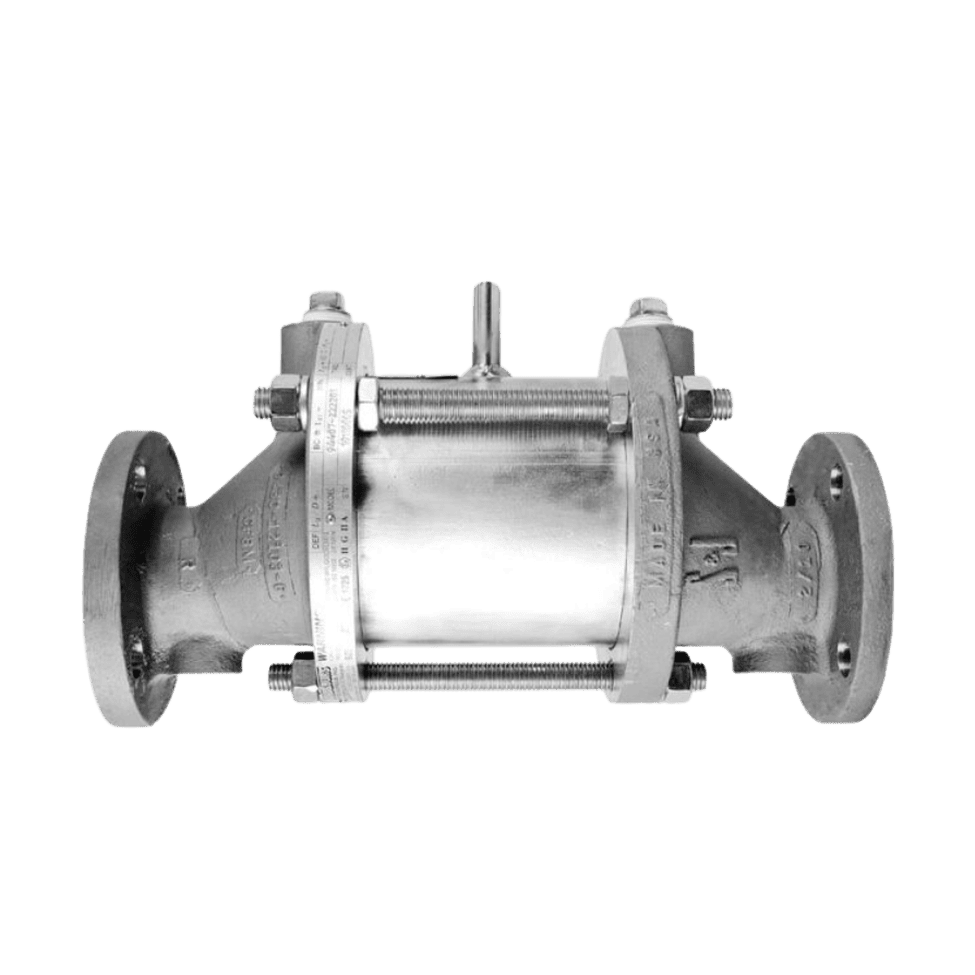
Shand & Jurs Model 94407 Horizontal Inline Deflagration Flame Arrester

The 94407 Horizontal Inline Deflagration Flame Arrester is designed for tank farm safety engineers, HSE and compliance managers, process operations leaders, and EPC project specifiers who need certified inline flame protection in horizontal low-pressure vapor piping where ignition can occur downstream of the protected equipment.

A spiral-wound crimped ribbon tube bank wrapped around a solid core absorbs heat from the flame front, dropping gas temperature below the ignition point while maintaining high flow capacity and minimal pressure drop.

The horizontal configuration is specifically arranged to prevent liquid accumulation within the element in wet-vapor service. The removable tube bank allows inspection without removing the unit from the piping.

Designed to ISO 16852 and ATEX EN 12874 for IIA / NEC Group D service, the arrester is available in 2–12 in. sizes with ANSI or EN 1092-1 flanges. Sizing can be verified with Shand & Jurs WinSize against API 2000 venting requirements.

Shand & Jurs Model 94307 Horizontal End-of-Line Flame Arrester
Shand & Jurs Model 94407 Horizontal Inline Deflagration Flame Arrester

Applications

  • Horizontal Vapor Piping and Tank Vent Headers: Installed in horizontal vapor piping and tank vent headers to stop deflagration from traveling back into the tank vapor space while preserving venting capacity during normal operation.
  • Digester Gas and Biogas Lines: Protects digester gas and biogas distribution piping where wet, low-pressure combustible vapor must flow through horizontal runs without flashback risk, with a condensate-tolerant element arrangement.
  • Vapor Recovery Headers and Process Vent Manifolds: Applied in vapor recovery headers and process vent manifolds where a certified inline deflagration boundary is required to protect upstream tanks and equipment in horizontal routing.
  • Flare Branch Lines: Safeguards flare branch connections from flame travel back into connected process systems while maintaining the flow capacity required for routine and upset vapor release.
02

Technical Specifications

Parameter

Specification

Model  

Shand & Jurs® 94407 Horizontal Inline Deflagration Flame Arrester

Technology  

Spiral-wound crimped ribbon tube bank on solid core, horizontal inline

Size Range  

2″, 3″, 4″, 6″, 8″, 10″, 12″

Max Static Pressure  

3.45 barg (50 psig)

Operating Pressure  

2–6″: 1.10 bara (16.20 psia); 8–12″: 1.09 bara (15.95 psia)

Max Operating Temperature  

140 °F (60 °C)

Gas Group  

IIA (NEC Group D)

Factory Approvals  

Designed to ISO 16852 (Short Term Burn) and ATEX EN 12874

Installation  

Horizontal inline

Installation Run-Up  

2–4″: 50 pipe diameters; 6″: 20 pipe diameters; 8–12″: 10 pipe diameters

Body Materials  

Aluminum (ISO 16852 only, FF flanges), Carbon Steel, or 316 Stainless Steel

Tube Bank  

Carbon Steel or 316 Stainless Steel

Hardware  

316 Stainless Steel

Gaskets  

High-temperature synthetic composition

Flange Options  

ANSI 125/150 or EN 1092-1 PN10/16; FF or RF

Condensate Handling  

Optional drain connection for body condensate removal

Monitoring Ports  

Optional temperature monitor connection

Sizing Support  

Shand & Jurs WinSize software; API 2000 venting compatibility

Typical Applications  

Horizontal vapor piping, digester gas lines, vapor recovery headers, flare branch lines, process vent manifolds, tank vent headers

Support
2026 COST ESTIMATE

Support

If you have questions not covered here, please contact the Cognesense support team for assistance.

Contact Us

When should I use the Model 94407 instead of a vertical inline or end-of-line arrester?

The Model 94407 is the correct choice for horizontal inline installations in low-pressure vapor piping, where its body geometry is arranged to prevent liquid accumulation within the element. For vertical inline runs, use the Shand & Jurs Model 94406 Vertical Series, and for open vent terminations use the 9430X end-of-line series.

How does the Model 94407 stop a deflagration?

+

The spiral-wound crimped ribbon tube bank wrapped around a solid core absorbs heat from the advancing flame front, dropping gas temperature below the ignition point and extinguishing combustion before it can propagate further. The element geometry holds pressure drop low to preserve normal venting capacity.

What are the installation run-up distances to the ignition source?

+

Maximum run-up from the ignition source to the arrester is 50 pipe diameters for 2–4 in. sizes, 20 pipe diameters for 6 in., and 10 pipe diameters for 8–12 in. sizes. Observing these limits is critical to the certified deflagration-arresting performance of the unit.

Which certifications and gas groups does the Model 94407 cover?

+

The arrester is designed to ISO 16852 (Short Term Burn) and ATEX EN 12874 for IIA / NEC Group D service. Aluminum body construction is approved for ISO 16852 only with FF flanges; carbon steel and 316 stainless steel bodies support both ISO 16852 and ATEX EN 12874 service.

How is element condition monitored, and what options support wet-vapor service?

+

Optional temperature monitor connections on the unprotected side support condition-based maintenance and regulatory compliance. An optional drain connection removes collected condensate from the body, and the horizontal element arrangement itself is designed to prevent liquid accumulation within the flame path.

Shand & Jurs
Measure.
Monitor.
Protect.