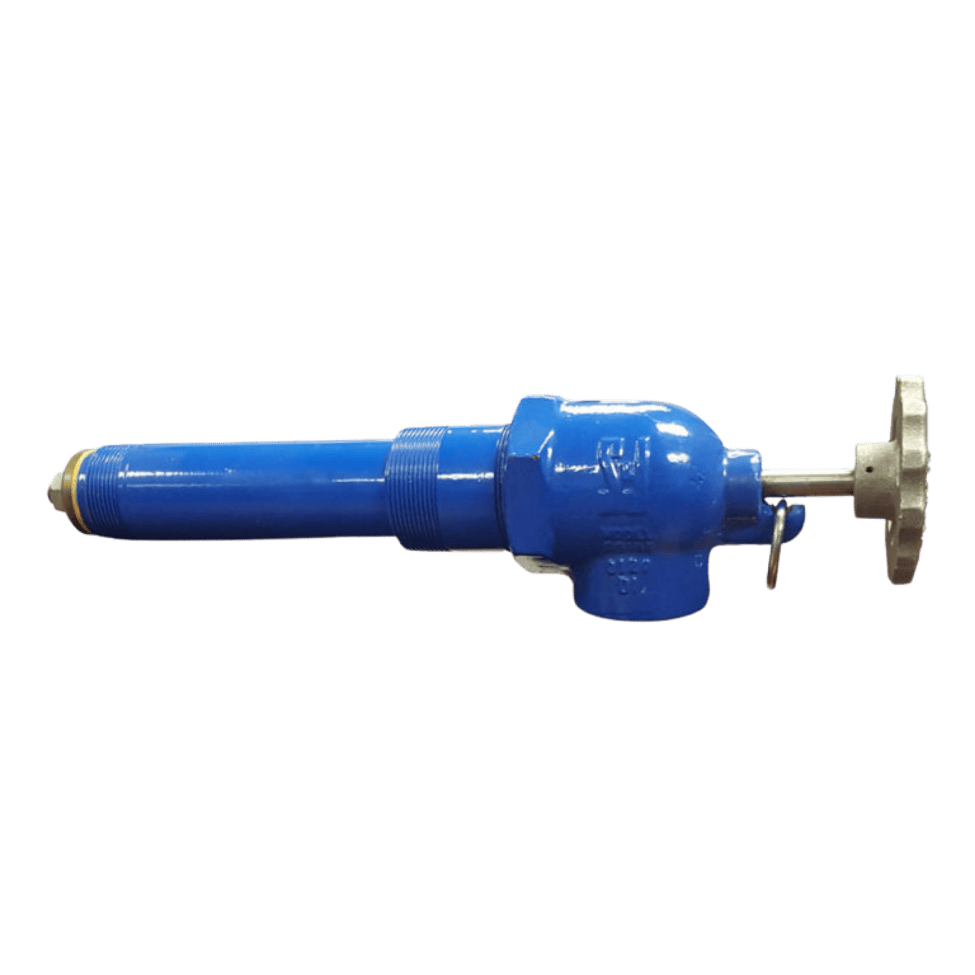
Water drain valves are tank-mounted devices that remove accumulated water from beneath stored petroleum products without releasing product to the environment. Water enters tanks through condensation, breathing, product contamination, and rainwater intrusion at roof fittings. Left undrained, it corrodes the tank floor, degrades product quality, skews inventory measurement, and fosters microbiological growth that accelerates tank deterioration.
The valve mounts on the tank shell drain nozzle at the bottom, where water settles beneath the lighter petroleum product. During a drain, the operator opens the valve and water flows out by gravity; when the water layer is exhausted and product begins to appear at the outlet, the operator closes the valve to prevent product loss. The category also includes automatic float-operated designs that sense the water and product interface, though many facilities rely on operator-controlled manual draining on a fixed schedule.
Water drain valves install on standard tank shell nozzles, typically 2 to 4 inches. Selection depends on the stored product’s specific gravity, the expected water accumulation rate, and the facility’s drain procedure. Discharge piping routes drained water to an oil/water separator for proper handling.
Water accumulates in petroleum tanks from condensation, breathing, and rainwater intrusion. Left in place, it corrodes the tank floor, degrades product quality, skews inventory calculations, and feeds microbiological growth. Regular draining at the tank-bottom nozzle protects the asset, the product, and the environment.
Water drain valves are specified on petroleum storage tanks where accumulated water must be removed regularly to protect the tank, the product, and the environment:
A positive, repeatable shut-off lets the operator close the valve the moment product appears at the outlet, keeping the water draw clean without spilling salable product.
Robust, simple mechanical operation holds up through thousands of drain cycles, easing the burden on staff who drain dozens of tanks on a rotating schedule.
Controlled drainage through a dedicated valve routes all drained water to the facility's oil/water separator or treatment system, giving the containment and documentation trail required by environmental permits and SPCC plans.
Purely mechanical, gravity-driven operation means the valve works reliably during power failures and control outages, with no dependency on utilities or instrumentation.
| Attribute | Elevated Flare | Enclosed Ground Burner | Utility Burner |
|---|---|---|---|
|
Combustion Type
|
Open flame at elevated stack tip | Enclosed flame in stack chamber at grade | Semi-enclosed or open flame at low elevation |
|
Typical Application
|
Emergency relief, high-volume intermittent venting | Continuous waste gas destruction, community-sensitive sites | Routine low-volume biogas or process gas flaring |
|
Visible Flame
|
Yes, visible from distance | No, flame contained within enclosure | Minimal, low-profile flame |
|
Noise Level
|
Higher due to open combustion and wind effects | Lower, chamber attenuates combustion noise | Moderate, depends on configuration |
|
Destruction Efficiency
|
95–98% typical | 98%+ with proper design | 95–98% typical |
|
Gas Flow Range
|
High capacity, wide turndown | Moderate capacity, wide turndown | Low to moderate capacity |
|
Footprint
|
Small ground footprint, tall stack required | Larger ground footprint, no elevated stack | Compact, minimal site preparation |
|
Best Fit
|
|
|
|
Consider an alternative when:
Operator-controlled drain valve giving a robust, repeatable shut-off at the tank-shell drain nozzle for tanks on manual water-draw schedules.