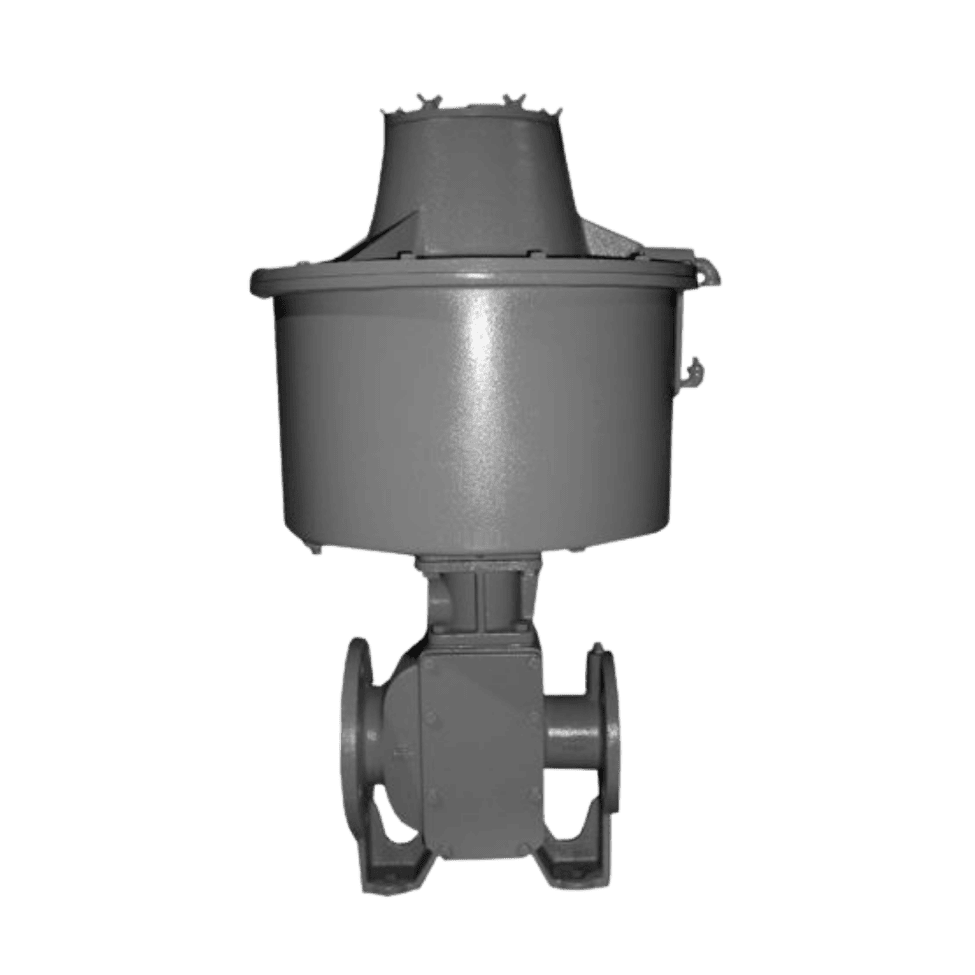
Tank blanketing valves and vapor recovery valves are pressure-regulating devices that manage gas composition inside a storage tank’s vapor space. Blanketing valves admit inert gas, typically nitrogen, when tank pressure drops below a set point, holding a positive blanket that keeps air out of the tank. Vapor recovery valves route displaced vapors to a collection system during filling rather than venting them to atmosphere. Together they address flammable vapor-air mixtures inside the tank and fugitive emissions outside it.
A blanketing valve senses vapor space pressure through a diaphragm. When withdrawal or thermal contraction drops pressure below the blanket set point, the valve opens to admit nitrogen, then closes when pressure recovers to conserve gas. A vapor recovery valve works in the opposite direction: when filling or thermal expansion raises pressure above its set point, it routes vapors to a recovery header or thermal oxidizer instead of releasing them through the conservation vent.
Both devices mount on tank roof nozzles and connect to gas supply or collection piping. Sizing follows API 2000 breathing-rate calculations. Blanketing valves are selected by blanket pressure and nitrogen supply capacity; vapor recovery valves by maximum vapor displacement rate.
Blanketing valves let gas into the tank, holding a protective inert atmosphere when pressure drops. Vapor recovery valves let vapor out of the tank, capturing displaced vapors during filling instead of venting them. A tank may use both: a blanketing valve to preserve the nitrogen blanket during withdrawal, a vapor recovery valve to capture vapors during filling.
Blanketing and vapor recovery equipment is specified when a tank requires inert atmosphere protection, emission capture, or both:
Precise set-point control and tight reseal open the valve only when tank pressure genuinely drops below the blanket threshold, cutting the purchased nitrogen consumed each year across multi-tank installations.
Vapor recovery valves capture displaced vapors at the source during filling, reducing the fugitive emissions that feed Title V inventories and eliminating visible plumes that draw complaints and regulatory attention.
The blanketing valve responds within seconds, holding the nitrogen blanket through rapid withdrawal cycles without letting air in through the vacuum path, preserving product integrity batch after batch.
Diaphragm-actuated blanketing valves and weight-loaded vapor recovery valves use mechanical designs with minimal moving parts, running reliably between maintenance intervals without electronic controllers or positioners.
| Attribute | Blanketing Valve | Vapor Recovery Valve | |
|---|---|---|---|
|
Primary Function
|
Admits inert gas (nitrogen) into the vapor space when pressure drops below the blanket set point | Routes displaced vapors to a collection or destruction system when pressure rises above the recovery set point | |
|
Gas Flow Direction
|
Into the tank, from the nitrogen supply header to the vapor space | Out of the tank, to a recovery header, scrubber, or thermal oxidizer | |
|
Trigger Condition
|
Tank pressure drops below the blanket set point during withdrawal, thermal contraction, or breathing | Tank pressure rises above the recovery set point during filling, thermal expansion, or blanketing overshoot | |
|
Actuation Method
|
Diaphragm senses pressure and opens the nitrogen port against a spring or weight | Weight-loaded pallet senses pressure and opens the vapor outlet to the recovery header | |
|
Regulatory Driver
|
NFPA 69 explosion prevention through inerting, product-quality inert-atmosphere specifications | EPA 40 CFR 60/63 (NSPS/NESHAP) vapor limits, state VOC regulations, Title V permits | |
|
Common Pairing
|
Pressure-only conservation vent for overpressure relief; the blanketing valve handles vacuum makeup | Conservation vent as backup atmospheric relief; the recovery valve captures most displaced vapor | |
|
Recommendation
|
|
|
Consider an alternative when:
Pair the blanketing valve with a pressure-only conservation vent for overpressure relief, a flame arrester at the vent outlet, and an emergency vent for fire-case protection to build a fully managed, closed-loop tank breathing system. See Pressure Conservation Vents, Flame, Deflagration & Detonation Arresters .
Combine with L&J Technologies level and pressure instrumentation feeding Clairvoyance to monitor blanket pressure, correlate nitrogen use with product movement, and flag valves cycling from set-point drift or seat wear. See Level Alarms and FuelsManager®.
Diaphragm-actuated nitrogen blanketing valve holding a precise inert blanket in the vapor space, conserving gas by opening only when pressure drops below the set point.
Weight-loaded vapor recovery valve routing displaced vapors to a collection header during filling, cutting fugitive emissions while holding proper backpressure on the recovery system.
Conditions blanketing or instrument gas by removing moisture, protecting downstream valves and preserving a dry inert atmosphere in moisture-sensitive storage.